The Conversation Manager

by Steven Van Belleghem

Which restaurant to trust: an open or closed kitchen?

by Steven 3. November 2010 16:05

Suppose you're in a town you've never been before and you're looking for a nice restaurant. Only this time, you forgot your Michelin Guide and the internet connections aren't working well. It almost sounds like a mission impossible these days, to look for a restaurant in those circumstances, isn't it?

Suppose you see two restaurants of which you like the menu they are communicating. Menu's are comparable, look & feel of the restaurants is comparable, but there is one small difference. Restaurant A has a great looking open kitchen, the chef is working in a very transparent room in the middle of the restaurant. Restaurant B has a closed kitchen and the only thing you see is some smoke that pops out of the kitchen door. Which restaurant will you choose?
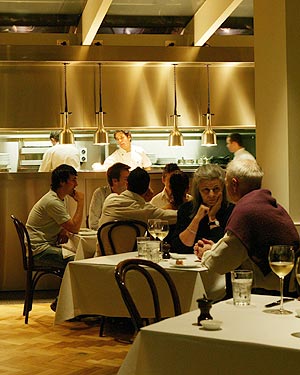
If we would do the experiment, most of us would go for the restaurant with the open kitchen. Why? Because it creates trust. An open kitchen has the advantage that it keeps the kitchen clean. If everybody can see how you work, there is no other option than to work in a nice and clean way. There is no room left to cheat on your clients.

This story is easy to understand for most managers and they agree with it. And still, it is hard for them to translate this simple metaphor into their own business context. The same philosophy is true for any brand in the world. If you are managing your brand from an open office, people will trust it more than when you don't act/communicate open. The open office is the evidence towards consumers that what you communicate is actually correct. They don't just belief you anymore. It's the stuff that you do that makes the real difference, not what you say.

Go for the open kitchen and show/proof your consumers that you are a trustworthy brand/company/product.

Bookmark and Share

Tags:

Say goodbye to the illusion of control

by Steven 2. November 2010 12:45

One of the most heard phrases at Marketing Conferences in the last 5 years was: 'Let go of control, it's not possible to control communication and consumers anymore'. Now we are 2010 and some companies really didn't get the message. It even scares the hell out of them, so they wanted to proof that they could still control things. This means that in 2010 we have a new mission towards larger enterprises: let go of the 'illusion of control'.

The policies that companies have in place to control word-of-mouth of their employees (like blocking Facebook, Twitter, ...) is not working and is even decreasing the business value of these companies.

By blocking social media two things happen:

  1. Your lousy employees find other ways to kill their time and are still not productive (you should fire them instead of blocking useful sites)
  2. Your superstar employees don't have the means to express their positive attitude towards consumers, suppliers and future employees, which decreases the value of your growth.

These people are the means necessary to promote your brand. A policy to stop people from communicating about your company is the biggest illusion there is in corporate life. This is the metaphor (I love metaphors :-)) I like to convince people about this.

Find yourself a wet piece of soap and find out what works best to hold the piece of soap: grab it as hard as you can or just open your hand and place the piece of soap on it....

Bookmark and Share

World's Best Presentation Contest '10

by Anke 29. October 2010 16:36

The Conversation Manager's presentation on the personality of the Conversation Manager has been nominated for the 'World's Best Presentation Contest '10'. Check out the presentation and cast your vote online if you like it.

View more presentations from steven van belleghem.

Bookmark and Share
Speeches

Speeches

Contact Steven for your private company speech, mail to ...

Check out the full calendar

Wall of fame

Follow the buzz (#CM48)


In his book, Steven Van Belleghem clearly describes how the relationship between brand and consumer has changed, and how that relationship could be revived through 'dialogue' between both parties. He uses several case studies to explain how to enter into that dialogue. It is a must read for those who recognize the limitations of traditional advertising, and for everyone who is eager to understand what makes the new consumer tick.

Henk Eising, International Market Research Manager Heineken