Blog

Category : business strategy
  • 5 dangerous arguments for not re-inventing your own business

    I’m writing this blog in Finland. I’m here for the week for different speaking opportunities and I can’t help but notice how ‘Angry Birds’ is everywhere here. It’s not that surprising, really, since Angry Birds was created by a Finnish company. Their change in business model is an interesting story, actually. They started out as a gaming industry outfit but now they are looking to position themselves as a Disney-style company. As in so many other countries, Angry Birds is omnipresent here thanks to merchandising, activity parks, etc. It’s a wonderful success story. Essentially they’re doing what Disney does but contrary to the Americans, their point of departure is not a movie or a cartoon. Instead, they built their empire around a highly successful game. This is a very clever business model innovation. This type of story is popping up everywhere now. Not rethinking your industry is a very dangerous thing to do these days. Still, every week I hear loads of excuses from companies that don’t see how this is relevant to them.

    Below I’ve listed the five most popular excuses. If you catch yourself or your company using them, think fast and correct your course.

    Read more »
  • The consumer is becoming our greatest competitor

    My parents owned a photography store in the small East Flemish town of Maldegem. Photo Video Van Belleghem had a solid reputation. My father took over the business from his father. For a few decades, the store was synonymous with good quality and friendly service until I broke the chain. I didn’t take over the family business – much to my parents’ delight by the way. After all, they had ringside seats as digitization claimed its first victim.

    In the mid-80s – and certainly in a provincial town like Maldegem – parents traditionally called in a professional photographer to immortalize their son’s or daughter’s first communion. People would line up to get that perfect picture taken but by the mid-90s, the long queues had dwindled to the odd passer-by. Digital photography completely uprooted the sector. Almost overnight, the introduction of digital cameras improved the quality dramatically and made cameras affordable. The competition in this story didn’t come from a fellow photographer or a low-cost competitor but rather from consumers themselves. All of a sudden, mom or dad or uncle Tony could make their own high-quality pictures. Making your own pictures also added a degree of authenticity and pride. No one was expecting the customer to become a competitor.

    Today, the process is repeating itself in the catering industry. A caterer’s biggest competitor is not the catering business that sets up shop nearby but the amateur chef at home. Serving catered food used to bring prestige but today it is a sign of culinary inadequacy. More and more industries are facing stiff competition from their own customers. The travel industry (with AirBnB), the clothes industry (eBay) and the media (YouTube) are just a few examples.

    Competing with the consumer’s hobby is extremely difficult. Resistance is not the answer. The travel industry is trying to fight AirBnB in court but even if they are successful in the short term, stopping the consumer is all but impossible in the long run. The proper reflex is looking for ways of creating your own added value in this new world. Maybe you can make things easier for consumers by helping them with their hobby. Or perhaps you could start an alternative business to surf the new trend. When the dam bursts, all you can do is adapt to the new reality dictated by the competitor-consumer.

    Read more »
  • How long can your current business model survive?

    The life expectancy of the average company is becoming shorter by the year. Last year there were a record number of bankrupties. This rapid changing of the guard is due to the fact that technology is evolving at an ever faster rate. Recent events have made it obvious that past success is no guarantee of future success. I’ve tried to come up with a story to motivate companies to re-invent themselves. You can read the full story in these slides:

    Read more »
  • The 5 dimensions of your digital infrastructure

    A digital strategy does not equal a Facebook strategy. Too many people place Facebook (or Twitter) in the heart of their digital approach. Facebook is great, but should probably not be the centre of your digital infrastructure.

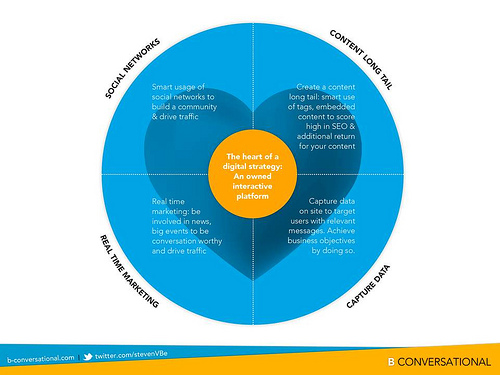
    Many managers wonder how Facebook likes bring in additional business. It is a valid concern to question the impact of likes on business results. Digital objectives should always be linked to business objectives. To build a bridge between a digital strategy and a business strategy, there are five dimensions to include in your digital infrastructure:

    1. Own interactive platform (used to be called a website)
    2. Smart usage of social networks
    3. Content long tail
    4. Ability for real time marketing
    5. Data strategy

    5 dimensions of digital infrastructure

    Read more »