A few months ago, an article in HBR claimed that ‘marketers are not publishing enough content’ and I must say I agree. All too often we get caught up in a discussion on the importance in content marketing of quantity versus quality.
In the online world, the answer is simple: it is about both quality AND quantity.
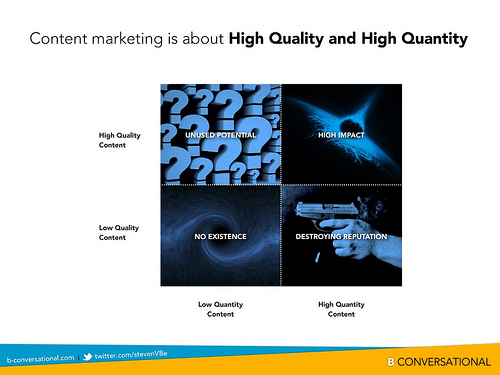
The current state of your content marketing falls under one of four possible categories:
- Non-existing: you don’t have a content marketing approach and as a result you’re in danger of fading from the memory of your market.
- Degenerating: you’re risking your reputation by frequently posting low-quality content. This is the fast track to destroying your corporate reputation and credibility.
- Untapped potential: this is the case when fantastic content fails to reach its target audience due to the low frequency with which that content is developed.
- High impact: this is the case when a lot of high-quality content is produced.
The rise of micro-content
In order to succeed on both a quality and a quantity level, it is important to create large chunks of content in combination with micro-content. Especially micro-content is on the rise. Companies and private individuals use small bits of content in a smart way to boost interaction and the number of views.
Back in the day we would put out one large piece of content, for instance a 15-minute movie, a 30-page white paper or a virtual product demo. Today, we still need these large chunks but it is also interesting to derive smaller variations from them.
Imagine, for instance, that you’ve created a 15-minute video. Why not derive two or three 30-second excerpts with key quotes or the catchiest remarks?
Another example: when you make a large PowerPoint deck, why not create three of four key visuals as well? These can be shared on Flickr or Pinterest, whereas the slides can be posted on SlideShare. In other words, you can create additional micro-content and spread it through various online channels. This approach allows you to communicate with different audiences.
Your key target group, the people that really love your work, may receive more content from you than in the past but since they like you, that’s not really an issue. Besides, they’re probably glad to hear more from you anyway. What the additional micro-content will do is increase the number of opportunities to communicate with those on the fringes of your target group, which will enable you to reach a larger target audience.
Read more »

 This guest post is written by Kristof De Wulf, CEO at InSites Consulting. Meet the InSites Consulting CCO (Chief Consumer Officer) Talk series, offering people from the C suite a chance to share their views on driving consumer centricity and activation in their organizations. This time, I had the opportunity to talk with Wouter Torfs, CEO of Schoenen Torfs. Schoenen Torfs is a Belgian family-owned shoe retailer, originated right after the First World War by Louis Torfs. Wouter Torfs took over as CEO in 1986, being a descendant of the third generation. Today, Schoenen Torfs realizes a turnover of more than 100 million euro, employs 570 employees and has been awarded 4 times as ‘Best Belgian Employer‘ by the Vlerick Business School. During my talk with Wouter, I wanted to find out about the recipe of success which brought Schoenen Torfs to where it is today.


 Looking for an inspirational speech for your next event? Book Steven Van Belleghem today or download our speakerfile and get inspired!