
Fifteen years ago, companies forced consumers to perform certain tasks themselves. When banks started charging customers for not executing their own transfers this led to widespread protest. Today the world looks very different: a company that doesn’t offer a self-service solution has to suffer the consequences.
In order to create an accurate picture of this trend, I conducted a global survey in collaboration with SSI, who conducted the actual study, and translation agency No Problem!.
The conclusion is inescapable: the majority of consumers favor a self-service solution, including the safety net of personal contact if the consumer so chooses. This trend is even more apparent in countries like China, Brazil and Singapore than is the case in Europe or the US.
The following presentation contains full details of the survey. As usual, downloading the study is free of charge:
As service expectations keep growing, self-service is the only answer
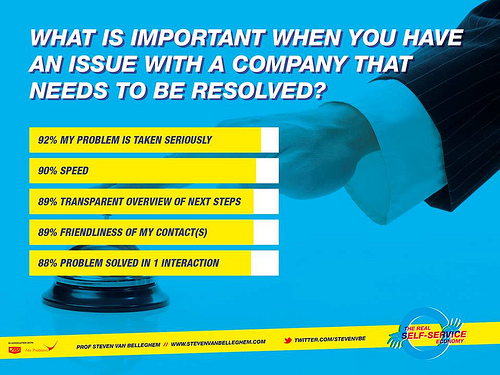
Consumers expect companies to keep improving their level of service. They want their questions answered and problems solved in a timely, friendly and efficient manner. Consumers have a strong aversion to having to contact a company several times or sharing the same information more than once.
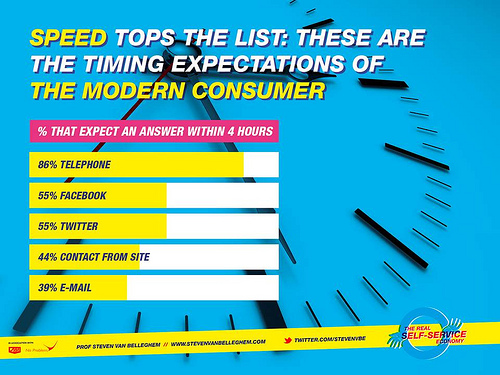
The days are long gone when it was OK to answer an e-mail inside 24 hours. 39% of modern consumers expect a reply within 4 hours. Twitter and Facebook users have even less patience. 55% of social media users want an answer in less than 4 hours.
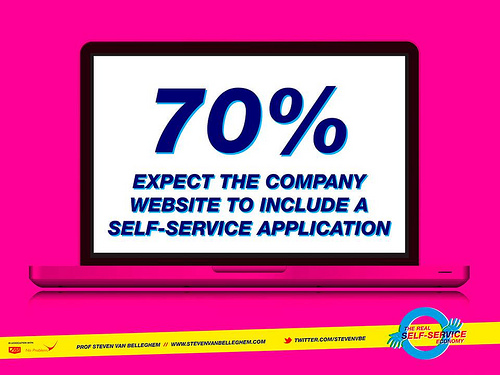
Self-service is the only long-term solution to meeting customer expectations. Already, 70% of consumers expect a self-service option for handling commercial questions and complaints. Still, this doesn’t preclude the need for a personal solution: if self-service falls short, personal contact as a safety net is an absolute necessity.
Self-service in every step of the customer relationship
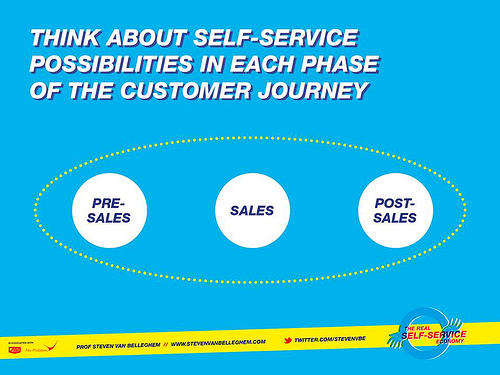
When mapping out a self-service strategy it’s useful to consider every single step in the customer relationship. Self-service relates to the pre-purchase phase as well as to the purchase as such and any questions that may arise following the purchase.
- Pre-sales: consumers make their own enquiries regarding a purchase. Quite often, 70% of the decision has already been made before a consumer contacts a company. 27% prefer to ask commercial questions over the phone whereas 56% opt for the self-service approach.
- Sales: the exponential growth of e-commerce shows that more and more people want to stay in control of the purchase process.
- Post sales: 35% prefer to ask questions over the phone, 48% choose the self-service option.
Strengthening the self-service economy through the use of data
The self-service economy can cement itself through the intelligent use of data. Data can improve the quality of the customer relationship in every phase of that relationship. As long as it’s to their own advantage, consumers are generally open-minded when it comes to giving companies access to their data.
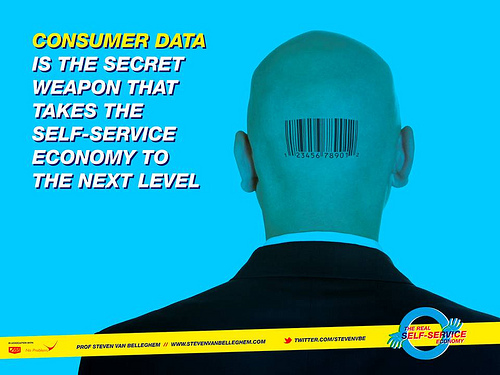
Pre-sales:
- 48% would like to receive personalized offers
- 43% would like to receive bespoke promotions
- 33% are interested in personalized advertising
Sales:
- 62% want faster and improved purchase possibilities through the use of client data
Post sales:
- 48% want companies to be able to track data through various channels so they don’t have to repeat themselves
- 81% are quite willing to grant access to data to help cut waiting times
The self-service economy is a win-win
When the self-service principle first started to take root, the underlying motivation for companies was often a search for efficiency. In their desire to create a super-efficient organisation, it seemed only logical to have the client perform certain tasks.
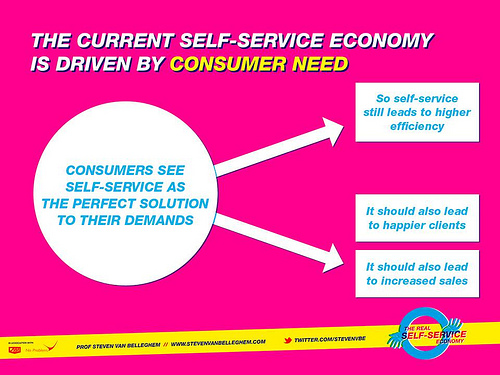
Today, the self-service principle can be much further-reaching. Self-service has the biggest impact when based on a win-win philosophy. The primary goal should always be an improved customer relationship. The advantages for the organisation are efficiency as well as higher profits.

Very interesting research, Steven. Thanks for sharing these insights.
I have to admit, the slides about the role of social networks in the self-service economy surprised me a little. However, social networks as a facilitator for customers helping other customers makes sense.
Could you elaborate a little more on the topic? Maybe in a future blogpost?
Good question and suggestion, Jochem. Next Tuesday, I’ll post something about this topic. Looking fwd to hear your thoughts on it.
another trend in self service is self consulting. tooliers provides tools that enable self consulting for SMEs.
same quality as using a reputable consulting firm, but at less than 10% of the price! technology enables consultants to “put their brain in tools” for helping a large number of customers, in real time.
Fantastic beat ! I wish to apprentice while you amend your site, how can
i subscribe for a blog website? The account helped me a
appropriate deal. I had been a little bit familiar
of this your broadcast provided vibrant transparent
concept