
These past few months I conducted a global study in collaboration with SSI (fieldwork & research) and No Problem! (translations). The object of the study was to look into new consumer trends regarding customer service in a digital world. The most striking conclusion was that the average consumer is becoming a genuine do-it-yourselfer. Both before, during and after the purchase, the modern consumer wants to stay in control as much as possible.
If this trend continues, customer service may shift from a personal to an automated world. If so, one could wonder if such a world will still have a need for webcare. Many companies are struggling with the large influx of tweets and Facebook messages. They have no long-term vision of how to deal efficiently with the sharp increase of questions on social media. Well, considering the results of our study, one might think it’s really not all that important anymore.
This concerns just 2% of consumers
We asked people what channels they use to contact companies when they have a question, both before and after a purchase. The two most popular channels are the telephone and self-service. What’s more, self-service is already the number one choice in every phase.
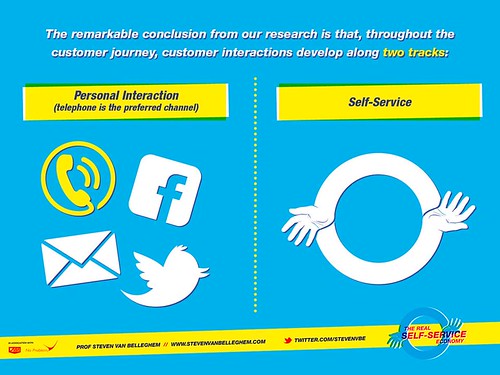
Only 2% of consumers today prefer to ask questions via social media. This is a very small group indeed.
We can formulate several hypotheses to explain this result:
- Many questions are personal and consumers have no desire to discuss them on a public platform
- Only a limited group of people ask questions or complain on social media and in the future they will turn to other channels
- This could just be the beginning, maybe there will be more questions in the future
My gut feeling tells me that the first explanation is key. The same trend is emerging all across the globe: a very small group of people prefers social media whereas the vast majority opt for self-service.
Actually, as a company, that’s the way I would hope the trend is going. After all, self-service offers huge efficiency advantages that answering questions on social media can never provide.
Naturally digital customer service remains important
The danger of this result lies in the fact that the opponents of digital customer service will get up and claim that investments in webcare are no longer necessary. Why invest in 2% of consumers?
This is, of course, the wrong conclusion. One percent may be a small percentage, but in actual numbers this still represents a large group of people. These consumers often have a slightly different profile than the average consumer. Someone who asks questions on social media has an open, direct personality and may also be loud in the offline world.
The indirect impact of social media is always bigger than the direct effect
The 2% are really raising their voice today. Just look at how KLM’s good work on Twitter and Facebook has given their reputation a boost. The online news spread offline and this had a positive effect on KLM’s reputation. In the future, companies that don’t offer online customer care will suffer indirect damage to their reputation. Indeed, the online news moves offline and when all of a sudden it’s reported in the mass media, the company is put in a bad light. The opposite creates a positive spiral.
In the end, online customer care may well turn into a digital commodity. Offering this service online is normal but it no longer improves your company image; not offering this service is totally unacceptable.
To summarize:
- The investment in webcare is for a small group of customers
- Naturally we are making this investment for those people, but also for the indirect impact it has on our reputation
- In the future, companies will invest in a super-efficient self-service system that will not only boost customer satisfaction but the company’s efficiency as well
Download the full study
Click here to view the full study and download it free of charge. Please feel free to let me know how you see the role of webcare in the future in light of these conclusions.

Great article. Self-service doesn’t have to be impersonal. It can and should be highly personalized and relevant. As you mention, self-service can boost loyalty, customer satisfaction and reduce servicing costs. Done right, it’s a win-win proposition.
Pingback: Redes Sociales: un gran poder conlleva una gran responsabilidad | Math Men
Dear Steven,
In this article you talk about “consumer” trends. Is this theory also applicable in a online B-2-B context ?
Best regards,
Renaat Declercq
Hi Renaat, data is only B2C, so no hard facts to answer your question. However, my gut-feeling: no difference between B2B and B2C.
Hi Stephen,
First and foremost congratulations on an excellent piece of work. I’m with you most of the way bar a suspicion you are overstating the ease and speed of transition to self service. Don’t ignore all the UX issues of the last 20 years around abandoned self service routines. They leave for the very reasons you state. No Time/low tolerance. That will improve slowly.
The other point is that all the evidence to date is that channels multiply rather than die. The issue in an impatient world is to design fast, low effort cross channel routines that suit the nature of the interaction.
To this end some of the legacy channels are being ported into a digital context e.g webRTC promises to mash up social text channels such as Twitter with online voice by offering click to call links via embedded links in the return tweet. Via a mobile device that starts to feel pretty intuitive.
So self service certainly fits the mood. But some levels of expertise will remain a live proposition even with machine to machine learning. Why? Because people still resonate best with people.
Martin
Pingback: Sólo el 38% de los mensajes enviados a través de Twitter son respondidos, y de promedio suelen tardar 6 horas y media | Math Men